Author: root

  • Can You Use Metal Pans in a Convection Microwave? B2B Supply Guide

    Can You Use Metal Pans in a Convection Microwave? B2B Supply Guide

    Why Metal Pan Compatibility Matters for Buyers

    Why Metal Pan Compatibility Matters for Buyers

    For B2B buyers sourcing convection microwaves, metal pan compatibility is not a minor feature. It affects product positioning, return rates, and channel risk.

    Impact on positioning, returns, and channel risk

    Misrepresenting or omitting metal pan compatibility in product listings creates avoidable downstream cost. Buyers who receive units incompatible with standard commercial cookware may face higher return rates and retailer chargebacks. Reverse logistics benchmarks from Optoro indicate feature-mismatch returns can reach 15–20% in appliance categories. Accurate specification documents at the sourcing stage help reduce this exposure.

    Buyer segments that need clear usage guidance

    The segments most exposed to compatibility confusion include:

    • **Foodservice equipment distributors** supplying commercial kitchens where metal bakeware is common
    • **Hospitality procurement teams** specifying countertop appliances for hotel or catering use
    • **E-commerce importers** listing multiple SKUs with different cavity materials

    Each segment needs clear factory confirmation on whether convection mode supports metal pans and under which operating conditions.

    Common importer and distributor mistakes

    Frequent sourcing errors include:

    1. Assuming all convection microwaves support metal pans; they do not when microwave mode operates simultaneously
    2. Failing to request cavity material specifications, such as stainless steel versus painted steel interiors
    3. Omitting mode-based usage restrictions from product data sheets sent to retail buyers

    When Metal Pans Can Be Used in a Convection Microwave

    When Metal Pans Can Be Used in a Convection Microwave

    Mode differences: convection, microwave, and combination

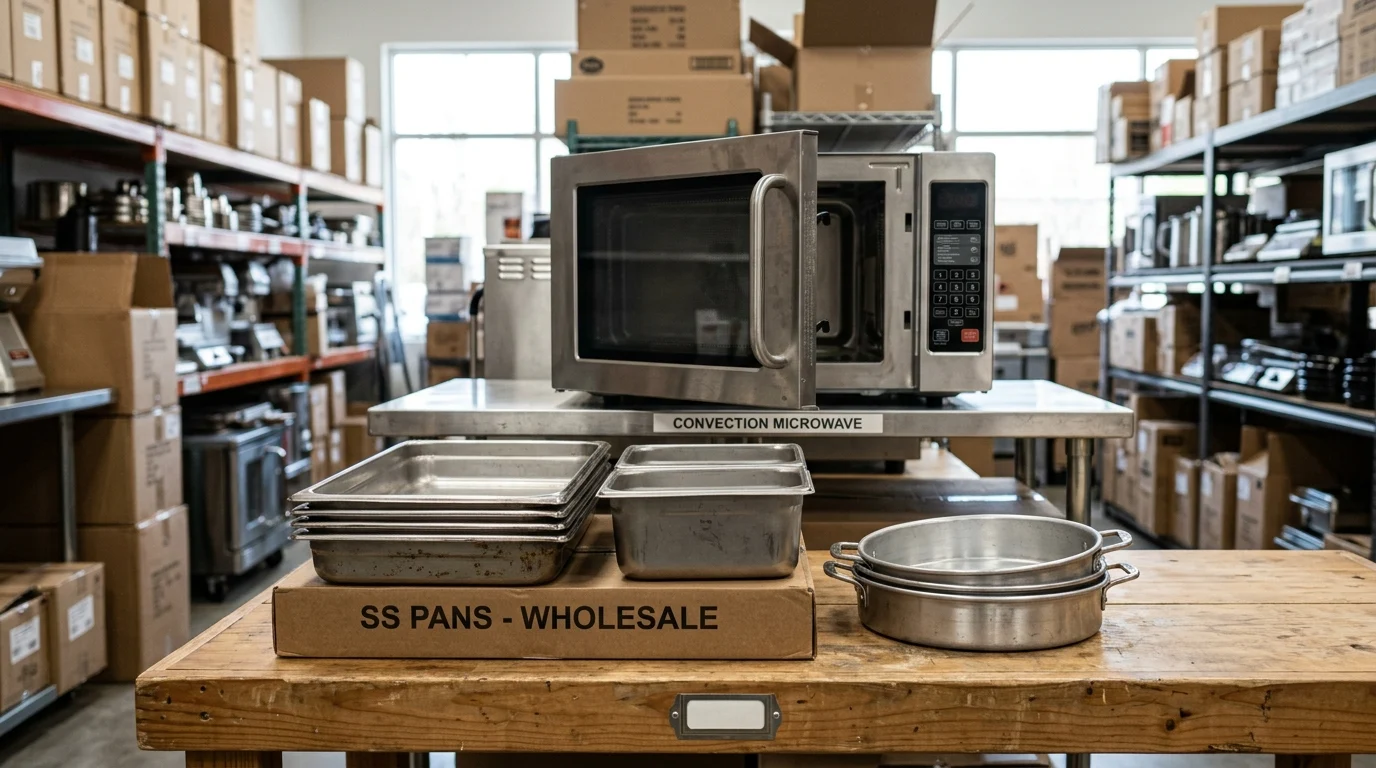
    A convection microwave has three operating modes. In **convection mode**, it works like a conventional oven, using hot air and a heating element; metal pans are generally compatible. In **microwave-only mode**, metal should not be used because it can reflect microwaves and cause arcing or equipment damage. In **combination mode**, metal use depends on the manufacturer’s instructions and the pan’s shape and construction.

    Allowed, restricted, and prohibited pan types

    | Category | Examples | Compatibility | |—|—|—| | Allowed | Stainless steel baking pans, aluminum sheet pans | Convection mode only | | Restricted | Dark anodized pans, pans with plastic handles | Check OEM specifications | | Prohibited | Pans with metallic trim or coatings, foil containers | Not for microwave-only mode |

    For bundled cookware programs, procurement teams should verify appliance and accessory documentation against applicable OEM safety requirements.

    Usage limits for manuals, packaging, and sales sheets

    Product documentation should state mode-specific restrictions clearly:

    • **User manuals**: Include metal-use guidance by operating mode
    • **Packaging**: Show warnings against metal use in microwave-only mode
    • **Sales sheets**: Identify supported appliance types and approved operating modes

    Technical Specs to Review Before Making Compatibility Claims

    Before making compatibility claims, procurement teams should gather unit-level specifications across four categories.

    Cavity, rack, turntable, and airflow design factors

    Evaluate internal cavity dimensions, rack positions, turntable diameter and load rating, and fan placement. Units with bottom-mounted fans typically require tighter pan clearance than rear-fan models. Confirm whether racks are fixed or adjustable.

    Pan material, shape, coating, and size effects

    Anodized aluminum, stainless steel, and carbon steel respond differently to convection heat cycles. Dark coatings absorb more energy and may increase browning near cavity walls. Rectangular pans in cylindrical cavities can restrict airflow and may increase arcing risk if edges are too close to high-field areas.

    Required comparison data for dimensions and clearance

    Collect manufacturer-published minimum clearance requirements, often 1–2 inches on all sides, and compare them with pan footprint, height, and handle protrusion. Request cavity schematics rather than relying only on marketing dimensions.

    Lab tests and validation data to request

    Request supplier documentation for IEC 60335-2-25 testing related to metallic accessory use, thermal performance data, and any UL or ETL certification covering accessory compatibility. For distributor-level compatibility claims, use third-party validation rather than internal QC summaries.

    How to Evaluate Suppliers and Accessory Programs

    When sourcing convection microwave accessories at scale, evaluate suppliers on technical compliance, program fit, and support, not price alone.

    OEM and ODM questions on trays, racks, and pan sets

    MOQ, tooling, private label, and after-sales support

    Packaging, manuals, and warning label requirements

    Compliance, Safety, and Liability Requirements

    Applicable certifications and food-contact rules

    Metal pans for convection microwave use must meet food-contact material requirements. In the U.S., relevant guidance includes FDA 21 CFR; in the EU, Regulation (EC) No 1935/2004 applies to materials in contact with food. Aluminum and stainless steel pans should be supported by documentation covering alloy composition, surface treatment suitability, and migration limits where required.

    Manual review to reduce misuse and warranty claims

    Procurement teams should require suppliers to state clearly whether each pan SKU is approved for convection-only cycles or for microwave-plus-convection combination modes. Missing or unclear use-case declarations increase warranty risk and operator liability.

    Recommended checks:

    • Confirm the rated temperature range, typically 230–260 °C for commercial convection
    • Verify that packaging does not make unsupported microwave-safe claims
    • Request supplier indemnification terms covering misuse-related claims

    Testing files, conformity records, and traceability

    Importers should request a technical file that includes:

    1. Material composition certificates for metal alloys
    2. Third-party test reports from accredited labs such as SGS, Intertek, or Bureau Veritas
    3. A Declaration of Conformity for the destination market
    4. Batch traceability codes linking production lots to test records

    These records support customs clearance, retailer audits, and recall readiness.

    Logistics, Packaging, and Cost Considerations

    Procurement teams sourcing convection microwave bundles must account for packaging geometry, unit economics, and supply-chain risk simultaneously.

    Accessory packing and carton efficiency

    Metal pans, racks, and turntable trays add dimensional weight and affect carton utilization. A standard 25 L convection microwave typically ships in a master carton of about 55 × 48 × 38 cm; nesting flat metal pans inside the cavity before boxing is a common factory practice that reduces void fill and keeps CBM per unit below 0.12 m³. Confirm whether accessories are packed inside the appliance or bagged separately, as separate packing increases DC pick-and-pack labor.

    Key cost drivers across models and bundles

    • **Metal pan material:** Aluminized steel pans usually cost 15–30% less than 430-grade stainless steel but may carry higher corrosion-return risk in humid markets.
    • **MOQ thresholds:** Many OEM factories set 500–1,000 units minimum for custom-branded bundles with metal accessories.
    • **Certification surcharges:** Expanding UL or CE scope to metal cookware components can add USD 800–1,500 per SKU in testing fees.

    Balancing landed cost, damage rate, and margins

    Damage rates on metal pans typically average 1–3% in sea freight when double-walled corrugated is used. Factor this into target landed cost, along with a 6–8% buffer for port surcharges and last-mile handling, to protect distributor margins.

    How to Communicate Metal Pan Compatibility Across Channels

    Consistent messaging across sales channels reduces confusion and returns related to misuse of metal pans in convection microwave units.

    Claim formats for catalogs, listings, and packaging

    Use one standardized compatibility statement across formats:

    • **Catalog/spec sheet:** "Compatible with convection and combination modes; not approved for microwave-only cycles."
    • **Marketplace listing:** "Convection Mode: ✓ | Microwave-Only Mode: ✗"
    • **Packaging:** Use IEC 60417-compliant oven-safe icons and a crossed-out microwave symbol when microwave-only use is prohibited.

    How to explain approved and prohibited use clearly

    Avoid vague terms such as "microwave safe." State approval by operating mode:

    • Approved: convection mode; combination mode at manufacturer-rated wattage
    • Prohibited: microwave-only mode due to arcing risk, equipment damage, and possible warranty invalidation

    Reference the appliance OEM operator manual as the authoritative source in distributor documentation.

    Training and rollout steps to reduce misuse and returns

    1. Train sales and customer service teams on mode-specific use before launch.
    2. Include a one-page compatibility reference card with each wholesale shipment.
    3. Track "incorrect mode" as a distinct return reason.
    4. Review return data quarterly and adjust claim language if misuse continues.

    Buyer FAQs and Key Takeaways

    Top sourcing, compliance, and claim-control priorities

    Verify IEC 60335-2-90 or the applicable national equivalent before approving metal cookware for convection microwave use. Request mode-specific test reports rather than broad “oven-safe” declarations.

    Whether stainless steel pans work in every mode

    No. Stainless steel pans are suitable only for convection and combination-bake modes, not pure microwave mode. Require clear bilingual labeling on each SKU to reduce misuse and return claims.

    Whether to bundle approved pans or source separately

    Bundling convection-approved metal pans with the appliance can increase order value and reduce compatibility disputes. However, align MOQs carefully, as pan suppliers often require separate minimums, typically 500–1,000 units per SKU. Confirm carton specifications and weight limits with your freight forwarder before final approval.

    Which documents to request before approving claims

    Request these documents from suppliers before accepting post-sale claims:

    1. Mode-specific test reports covering convection cycle, rated wattage, and temperature range
    2. Material certificates for the stainless steel or aluminum alloy used
    3. Signed compliance declarations citing applicable standards
    4. Photographic evidence of labeling on production units

    Complete documentation supports customs review and streamlines dispute resolution with retail and foodservice buyers.

    Key Takeaways

    • Wholesale sourcing and supply-chain implications for can you use metal pans in convection microwave
    • Specifications, compliance, and commercial terms buyers should validate
    • Actionable recommendations for distributors and procurement teams
  • Future Outlook for Water Dispenser Pipelines in B2B Supply

    Future Outlook for Water Dispenser Pipelines in B2B Supply

    \"Future

    Market Context and Strategic Outlook for Water Dispenser Pipelines

    \"Market

    The pipeline water dispenser market is entering a phase of sustained B2B expansion, driven by rising institutional demand across office complexes, hospitality, healthcare, and co-working segments. Global procurement interest — particularly from Southeast Asian and Middle Eastern distributors — is accelerating as buyers shift from bottled-water infrastructure toward plumbed-in, filtration-integrated solutions that reduce operational overhead and recurring consumable costs.

    From a supply-chain standpoint, Chinese OEM manufacturers dominate production capacity, with Guangdong and Zhejiang clusters offering the most competitive MOQ flexibility and private-label programs. Margin structures remain attractive for mid-volume importers, though logistics complexity around refrigeration-capable units and compliance with regional water-contact material standards (NSF, CE, RoHS) adds qualification lead time.

    Strategic buyers should monitor compressor technology improvements, UV-LED sterilization integration, and smart IoT connectivity features as the key differentiators shaping next-generation SKU selection and long-term category positioning.

    Why pipeline reliability is becoming a strategic procurement issue in B2B water dispenser supply

    Demand drivers across office, hospitality, healthcare, education, and commercial real estate channels

    How replacement cycles, retrofit demand, and preventive maintenance programs are shaping future volume

    Specification Priorities Buyers Should Track in Future Pipeline Programs

    \"Specification

    As pipeline water dispenser technology matures, procurement teams should monitor several specification thresholds that will increasingly define competitive product tiers. Filtration stage count is moving from the current market standard of three to five stages toward six- and seven-stage configurations incorporating RO membranes with sub-0.0001-micron retention ratings. Heating and cooling response times are becoming a differentiating spec, with leading suppliers targeting instant-heat modules that deliver 100°C output within three seconds. Energy efficiency ratings — particularly standby power consumption below 5W — are gaining traction as commercial buyers face tightening ESG reporting requirements. Smart connectivity features, including app-based filter-life monitoring and flow-rate diagnostics via Wi-Fi or Bluetooth, are transitioning from premium add-ons to baseline expectations in mid-tier SKUs. Buyers negotiating forward contracts should build these thresholds into product specifications now to avoid catalog obsolescence within a 12–18 month sourcing cycle.

    Material selection trends: food-grade plastics, silicone, stainless steel interfaces, and durability trade-offs

    Pressure tolerance, temperature range, bend radius, odor resistance, and long-term performance metrics

    Compatibility with countertop, freestanding, bottleless, and plumbed-in dispenser platforms

    Standardization opportunities for fittings, diameters, connector systems, and modular replacement parts

    Supplier Sourcing Strategy and Manufacturing Evaluation

    As water dispenser pipeline systems gain traction across commercial and institutional procurement channels, supplier evaluation must extend beyond unit pricing to encompass manufacturing capability, component traceability, and compliance readiness. Buyers sourcing from Chinese OEM manufacturers should assess factory certifications (NSF, GB/T, ISO 9001), filter media sourcing, and RO membrane provenance — particularly as regulatory scrutiny on food-contact materials tightens in the EU and North American markets. MOQ thresholds for private-label pipeline units typically range from 200–500 units per SKU, with lead times of 45–75 days depending on customization depth. Distributors entering this category should negotiate tooling ownership clauses and request third-party lab reports covering heavy metal leaching and microbial performance. Dual-sourcing strategies are increasingly advisable given component supply volatility, especially for smart-enabled models reliant on IoT chipsets subject to ongoing semiconductor constraints.

    How to assess OEM versus ODM pipeline suppliers for private label and contract manufacturing programs

    Factory audit priorities: extrusion capability, cleanliness control, traceability, testing routines, and process consistency

    MOQ, lead times, tooling requirements, sampling workflows, and cost implications for custom specifications

    Dual-sourcing and regional diversification strategies to reduce disruption risk in pipeline procurement

    Compliance, Safety, and Documentation Requirements in International Trade

    Compliance, Safety, and Documentation Requirements in International Trade

    Exporters and importers of water dispenser pipeline units must navigate a layered compliance environment that varies significantly by destination market. Key certifications include NSF/ANSI 42 and 53 for filtration performance, CE marking for European market entry, and RoHS compliance for restricted substances in electronic components. Food-contact material declarations — particularly for tubing, fittings, and internal reservoirs — are increasingly scrutinized by customs authorities in the EU, US, and GCC markets. Procurement teams should require full material safety data sheets, third-party lab test reports, and country-of-origin documentation from suppliers before committing to volume orders. For cross-border shipments, HS code classification (typically under 8422 or 8516 depending on heating/cooling functionality) directly affects tariff rates and duty drawback eligibility. Maintaining audit-ready documentation is essential for both regulatory clearance and downstream retailer onboarding requirements.

    Key food-contact and drinking-water compliance considerations for export markets

    Documentation buyers should request: material declarations, test reports, batch records, and quality certificates

    How regulatory variance by destination market affects sourcing decisions and product line segmentation

    Managing liability exposure through supplier agreements, inspection protocols, and incoming quality standards

    Cost Structure, Packaging, and Margin Management

    Cost Structure, Packaging, and Margin Management

    Factory gate pricing for pipeline water dispensers typically ranges from $45–$120 per unit depending on filtration stages, heating/cooling modules, and smart connectivity features. For distributors, landed cost after freight, tariffs, and compliance testing generally lands 25–40% above FOB price, compressing gross margins to 18–30% at mid-market price points unless volume commitments unlock tiered rebates.

    Packaging specifications matter significantly for B2B channel economics: export cartons rated for double-stacking, foam-insert protection for ceramic filter housings, and bilingual labeling for dual-market SKUs all affect per-unit logistics cost. Buyers sourcing at 500+ unit MOQs can typically negotiate private-label packaging, reducing downstream branding costs.

    Margin management increasingly depends on bundling installation kits, filter replacement subscriptions, and extended warranty programs — shifting revenue from one-time hardware sales toward recurring service income that improves account lifetime value for distributors.

    Breaking down unit cost drivers: raw material volatility, tolerances, connectors, labor, and scrap rates

    Packaging formats for wholesale efficiency: bulk coils, cut-to-length kits, service packs, and private-label cartons

    Balancing landed cost with warranty risk, service call reduction, and channel margin protection

    When buyers should prioritize standardized SKUs versus customized pipeline assemblies

    Logistics, Inventory Planning, and Aftermarket Supply Continuity

    Effective inventory planning for water dispenser pipelines requires distributors to account for longer replenishment cycles driven by component complexity — filtration modules, UV sterilization units, and chilling assemblies each carry distinct lead times. B2B buyers sourcing from OEM manufacturers in China should build buffer stock of 60–90 days given port congestion variability and seasonal demand spikes in Q2 and Q4. Aftermarket supply continuity is a growing differentiator: procurement teams increasingly negotiate filter cartridge supply agreements alongside hardware contracts, locking in SKU availability and pricing for 12–24 month windows. MOQ thresholds for replacement parts typically run lower than for finished units, enabling leaner stocking strategies for service networks. Distributors managing multi-brand portfolios should standardize on compatible filter interfaces where possible to reduce SKU fragmentation and improve warehouse turn rates across their aftermarket inventory.

    Freight and storage considerations for flexible tubing, connector sets, and mixed-component shipments

    Forecasting demand for OEM production, distributor stock, and aftermarket replacement programs

    Inventory segmentation by fast movers, critical spare parts, and low-volume legacy models

    How service network requirements influence safety stock, replenishment cycles, and fulfillment model design

    Channel Strategy and Competitive Positioning for Distributors and Importers

    Channel Strategy and Competitive Positioning for Distributors and Importers

    Distributors entering the pipeline water dispenser category should prioritize tiered channel segmentation — separating corporate account programs from hospitality and healthcare verticals, each of which carries distinct procurement cycles and compliance requirements. Importers sourcing from Chinese OEM manufacturers benefit from negotiating exclusivity clauses tied to regional SKUs, particularly for models featuring proprietary filtration configurations or smart connectivity modules, which are harder for parallel importers to replicate. Margin protection increasingly depends on value-added services: installation networks, filter subscription programs, and after-sales service contracts that commodity-focused competitors cannot easily undercut on price alone. As domestic Chinese brands accelerate overseas expansion through direct B2B e-commerce platforms and regional distributor agreements, established importers should leverage certified compliance documentation — NSF, CE, or local water quality certifications — as a credible barrier to entry and a procurement justification tool for institutional buyers.

    Selling pipelines as a margin-supporting consumable and service component rather than a commodity alone

    Bundling opportunities with filters, valves, fittings, sanitation kits, and maintenance contracts

    Private label positioning, catalog architecture, and technical sales support for B2B channel growth

    Using quality differentiation, documentation depth, and supply assurance to win institutional accounts

    FAQ

    FAQ

    What is driving demand growth for water dispenser pipelines in B2B channels? Expansion of commercial real estate, co-working spaces, and institutional procurement programs is the primary demand driver. Stricter municipal water quality regulations in key markets are also pushing facility managers toward inline filtration systems over bottled alternatives.

    What MOQs should importers expect from OEM suppliers? Most Tier-1 manufacturers in Guangdong and Zhejiang set MOQs between 200–500 units per SKU for standard pipeline models, with custom branding requiring higher minimums, typically 500–1,000 units.

    How is technology shaping the next product cycle? IoT-enabled filter monitoring, app-based maintenance alerts, and modular multi-stage filtration are becoming baseline expectations in commercial tenders. Distributors sourcing ahead of the next cycle should prioritize suppliers with certified smart-module compatibility to remain competitive in institutional and hospitality procurement bids.

    What pipeline certifications matter most when importing for commercial water dispenser programs

    How should buyers compare suppliers when quoted prices differ but specifications appear similar

    What is a practical MOQ strategy for launching private-label replacement pipeline SKUs

    How can distributors reduce returns and field failures in replacement pipeline sales

    When is custom tubing justified versus stocking universal pipeline options

    Key Takeaways

    Key Takeaways

    Water dispenser pipelines are transitioning from a consumer convenience product into a core procurement category for B2B buyers across hospitality, corporate facilities, and institutional channels. Demand growth is being driven by tightening water quality regulations, rising hygiene standards, and the shift away from bottled water logistics. For distributors and importers, the near-term opportunity lies in tankless, instant-heating pipeline units with multi-stage filtration — segments commanding stronger margins and repeat consumable revenue. Supply chain consolidation among Chinese OEM manufacturers is improving MOQ flexibility and private-label accessibility, lowering barriers for regional distributors. Compliance with NSF, CE, and local food-contact material standards will increasingly serve as a market-entry prerequisite rather than a differentiator. Buyers who establish preferred-supplier agreements now, while the category is still fragmenting, are best positioned to capture volume as corporate procurement standardizes around pipeline dispenser solutions.

    Future competitiveness will depend on specification control, compliance readiness, and supply continuity

    Lowest unit price is rarely the best buying strategy when warranty risk and field service costs are included

    Buyers that standardize core SKUs while preserving flexibility for custom programs can protect margin and availability

    See Also

    See Also

    – [Water Dispenser Pipeline Sourcing Guide for B2B Buyers]() – [MOQ and Packaging Standards for Countertop Water Dispensers]() – [Compliance and Certification Requirements for Water Filtration Equipment in Export Markets]() – [Tankless vs. Tanked Pipeline Dispensers: A Procurement Comparison]() – [Key Suppliers and OEM Manufacturers of Pipeline Water Dispensers in China]() – [Margin Analysis and Channel Strategy for Water Dispenser Distributors]() – [Logistics and Cold-Chain Considerations for Water Appliance Imports]() – [Emerging Markets for Instant-Hot Water Dispensers in Commercial Foodservice]() – [Smart Water Dispenser Technology: IoT Integration and B2B Procurement Implications]() – [Trade Show and Sourcing Event Calendar for Water Treatment and Dispenser Categories]()

    How to Evaluate OEM Water Dispenser Component Suppliers for Long-Term B2B Partnerships

    Import Compliance Checklist for Food-Contact Components in Commercial Beverage Equipment

    Packaging and MOQ Planning for Private-Label Spare Parts Programs

    Building Aftermarket Parts Revenue in Commercial Water Equipment Distribution

    Key Takeaways

    • Wholesale sourcing and supply-chain implications for 管线机的未来发展状况预测
    • Specifications, compliance, and commercial terms buyers should validate
    • Actionable recommendations for distributors and procurement teams

  • Hello world!

    Welcome to WordPress. This is your first post. Edit or delete it, then start writing!